Neighborhood Schools: The (Current) Missed Opportunity

The relationship between neighborhoods and schools is an important element in community building, and has been since the early years of the United States.  The importance of this relationship is rooted in the value that has always been placed on education and the opportunities of self improvement that come from an increase in knowledge which stems from education.  Historically, one of the first (if not the first) civic buildings that are constructed in a community would have been a school.

Conventionally segregated school | Rose Creek Elementary (Riverton, UT)

Conventionally segregated school | Rose Creek Elementary (Riverton, UT)

As with many other aspects of community building, our more recent history in the United States has involved the separation and compartmentalization of schools from the neighborhoods that they are intended to serve.  Over the past sixty years our school children have been directly affected by changes in the way our schools are sited.  Schools have moved further from their students and have grown in size as they have gravitated outward from the neighborhood.  Child obesity rates have also seen a rapid increase over the same time, while the number of students who walk to and from school has dropped sharply.  These results are highly connected to land use policy and the increasing reliance that Americans have on the automobile.  It has also affected the ability of school districts to balance their budgets and to provide the level of education that they would prefer to give if circumstances were different.

As an example, there was a recent news story in Utah which illustrates the negative impacts of school sites being out of scale with their community. In a Deseret News article (dated August 3, 2010), it was reported that the Jordan School District would be cutting bus routes because of budget constraints.  A few months later, on Dec. 10, 2010, a mother in South Jordan, UT was given a citation for allowing her kindergarten age son to walk to and from his school (CLICK HERE to read news article from the Deseret News).  In this particular instance the child was well equipped to make the walk to school, outfitted in an orange vest and helmet to increase visibility.  The child’s mother had mapped out a route for the child that allowed for walking on sidewalks rather than the shoulder of the road.  The reason the child was walking to school in the first place was because of the school district budget cuts which eliminated bus routes associated with hazardous walking conditions.  One of the effects of the routes being cut was causing children to either get a ride from their parents or be forced to walk along busy or dangerous roads and hazardous areas.  Interesting cause and effect, wouldn’t you say?

Source: Daybreak (South Jordan, UT)

Source: Daybreak (South Jordan, UT)

What is intriguing about the recent discussion in Utah pertaining to school districts reducing bus routes in order to save on budgetary shortfalls is the recognition of the reasons that districts have to bus their students in the first place.  The two most prominent reasons for busing students are distance and safety.  Ironically, these are both issues that are outside of a school district’s ability to control, yet they are faced with the repercussions of how our communities are assembled.  When a student is too far from their school they have to find other alternatives (including the school bus) to get themselves to and from school.  These distances will often stem from Euclidean zoning principles which mandate the separation of uses and the favoring of large lot, single family detached homes.

When a student lives within a walkable distance of school, but the route to school is deemed too unsafe to walk, again the school district is often faced with the budgetary responsibility of having to move children to and from school using bus services.  Both of these issues are the result of the lost opportunities of not working together to better integrate the building blocks of community, making more responsible decisions about how our neighborhoods are designed and assembled, and the understanding of the financial benefits associated with better decision making.

A major cost that can be drastically reduced by cutting down on school size and by locating schools within a walkable distance of the residents they serve, is the expense for busses.  To reduce busing, more kids will need to walk to school, and the design of the neighborhood has a major impact in this regard.  One study found that students living within one mile of school were three times more likely to walk rather than travel by automobile[1].  Location of schools is a major player dictating walkability.

Neighborhood integrated school | Eastlake Elementary (South Jordan, UT)

Neighborhood integrated school | Eastlake Elementary (South Jordan, UT)

Why can’t circumstances be different than what they are?  Why can’t schools be reestablished as essential centers within neighborhoods?  Why can’t a model for high performance schools be used for the greater good of all involved?  The easy answer is – it can!

A great place to start is to look at a tool called the Smart Growth Schools Report Card.  This particular tool is meant to demonstrate best practices to assist with the decision making necessary for better results in creating neighborhood schools.  If communities are able to save money, reduce environmental impacts of schools in the community, improve the health of their students, and increase long term support for the school system why would we not want to do act.  Better results will come as we think and act more responsibly.

Article co-authored by Graham Larson

[1] McMillan, TE. (2007). “The Relative Influence of Urban Form on a Child’s Trip to School.” Transportation Research Part A: Policy and Practice, 41(1): 69–79.

Accessory Units: A Community’s Opportunity for Hidden Density

Accessory units are the most effective way of providing density within a neighborhood while simultaneously providing the lightest impact to the neighborhood.  It allows the property owner to be selective of the occupant because they are sharing space and utilities.  It allows for the property owner to subsidize their own mortgage with the rent from the accessory unit. 

LDS Ward Creation – Applying “Missing Middle” Housing

Over the course of the past few years I have been analyzing the relationship between housing types and their impact(s) on the health and well-being of LDS Wards.  For those that may be unfamiliar with what a “Ward” is, let me explain to provide adequate perspective:

A “Ward” is a membership group (similar to a congregation in other religions) that is made up of members of the Church of Jesus Christ of Latter-day Saints within a determined geographical boundary. Within a membership group of an LDS Ward are a number of “auxiliaries” which include sub-categories of the larger membership group.  There is an auxiliary group for children (Primary), two for teenagers (Young Men & Young Women), one for women (Relief Society), and two for men (Elders & High Priests).  It is important to note that the reason for the different auxiliary groups is because each has different needs within the ward as an organizational unit.  The different groupings allow for each to have its needs addressed in a specific manner to those within their respective auxiliary group.

An LDS Ward also functions as an organization intended to both produce and provide service/welfare activity for the benefit of the Ward itself.  The optimal goal in producing and providing service/welfare activity within the Ward is to strengthen its own ability to be self-reliant – meaning it can generate a balance between its capacity to both produce and provide for the needs within the Ward itself.  The membership make-up of the LDS Ward is critical to its ability to balance between its production and providing capacities.  If the make-up of the Ward is too heavily weighted in the direction of needing to provide service/welfare without enough people to produce for the need within the Ward then self-reliance can’t be achieved.  The Ward must then go outside of its own structure in order to meet its own internal needs.

LDS Ward Boundaries: Impact of Housing Types

LDS Ward Boundaries: Impact of Housing Types

There is also potential sensitivity in providing service/welfare within an LDS Ward.  Service/welfare typically occurs in two ways; through the offering of time and/or money.  It is important to note, that the demographics within a ward can have an impact on how service/welfare is provided.  Both time and money are needed, but an imbalance of one or the other can generate constraints in a Ward’s ability to be self-reliant in providing service/welfare.  The demographics of an LDS Ward is a major contributing factor as to whether time, money, or both will be at the disposal of the Ward for service/welfare needs.

The understanding of an LDS Ward’s mission in providing for its members becomes a very important element in the story which is why there is interest in attempting to better understand the relationship between the housing stock within a Ward’s boundaries and the sub-categories of membership that the housing stock generates which play a contributing role to the overall health of the Ward to function as intended.  The significance of the relationship stems from the consequences that are emitted based on the degree of diversity that exists (or lack thereof) based on the associative mix of housing within a Ward’s boundary.

The relationship between housing and LDS Ward membership became an area of analysis as I began a collaborative working relationship with the LDS Church’s Meetinghouse & Facilities Department (MFD).  As we began working together we quickly identified areas of overlap as to where our specific responsibilities could become mutually beneficial as we worked together.  A particular area of shared interest revolved around the understanding that the LDS Church had, in recent history, been subject to reactive decision making as development growth occurred along Utah’s Wasatch Front.  With the concentration of membership along the Wasatch Front it limited the Church’s ability to proactively plan for and manage the impacts of growth as it pertained to the short and long term self-reliance of LDS Wards.  Since Conventional Suburban Development (CSD) growth is the dominant development pattern there are management challenges that ensue – most notably, large tracts of land area containing limited to no mix of housing types.  The reason for concern stemmed from the recognized link between housing and the associative demographics that are then tied to the available housing.  Housing has proven to act as a “container” of sorts for the emission of LDS Ward membership within the previously identified sub-categories.  If the containers are the same, so too is the Ward membership.  When this is the case it has been shown to lead to the creation of LDS Wards that seem to inevitably collapse on themselves within a 20-30 year life cycle, because there is little to no opportunity for the wards to regenerate – the homogeneous housing stock doesn’t allow for it.

CSD Example | Country Crossing (South Jordan, UT)

CSD Example | Sunstone neighborhood (South Jordan, UT)

Contrary to the CSD pattern was analysis of Traditional Neighborhood Development (TND) patterns.  The area of interest between the two development patterns revolves around the amount and degree of housing type mix emitted between the two development patterns.  Specifically, when a TND pattern was present there is typically a much higher level of housing type diversity within a more compact area in relation to a CSD pattern.  What this meant, upon precursory analysis, was the TND neighborhoods were more balanced in their emission of LDS Ward membership in the short term, and much better conditions for positive rejuvenation in the long term.

It is important to note that the LDS Church can only react to the pattern that gets built, regardless of the fact that one may be more advantageous than the other.  This will always be the case with the exception of when they own the land directly.  If the land is owned by the LDS Church the opportunity exists to position the land, ahead of actual development, so that it has the capacity to emit a more advantageous development pattern.

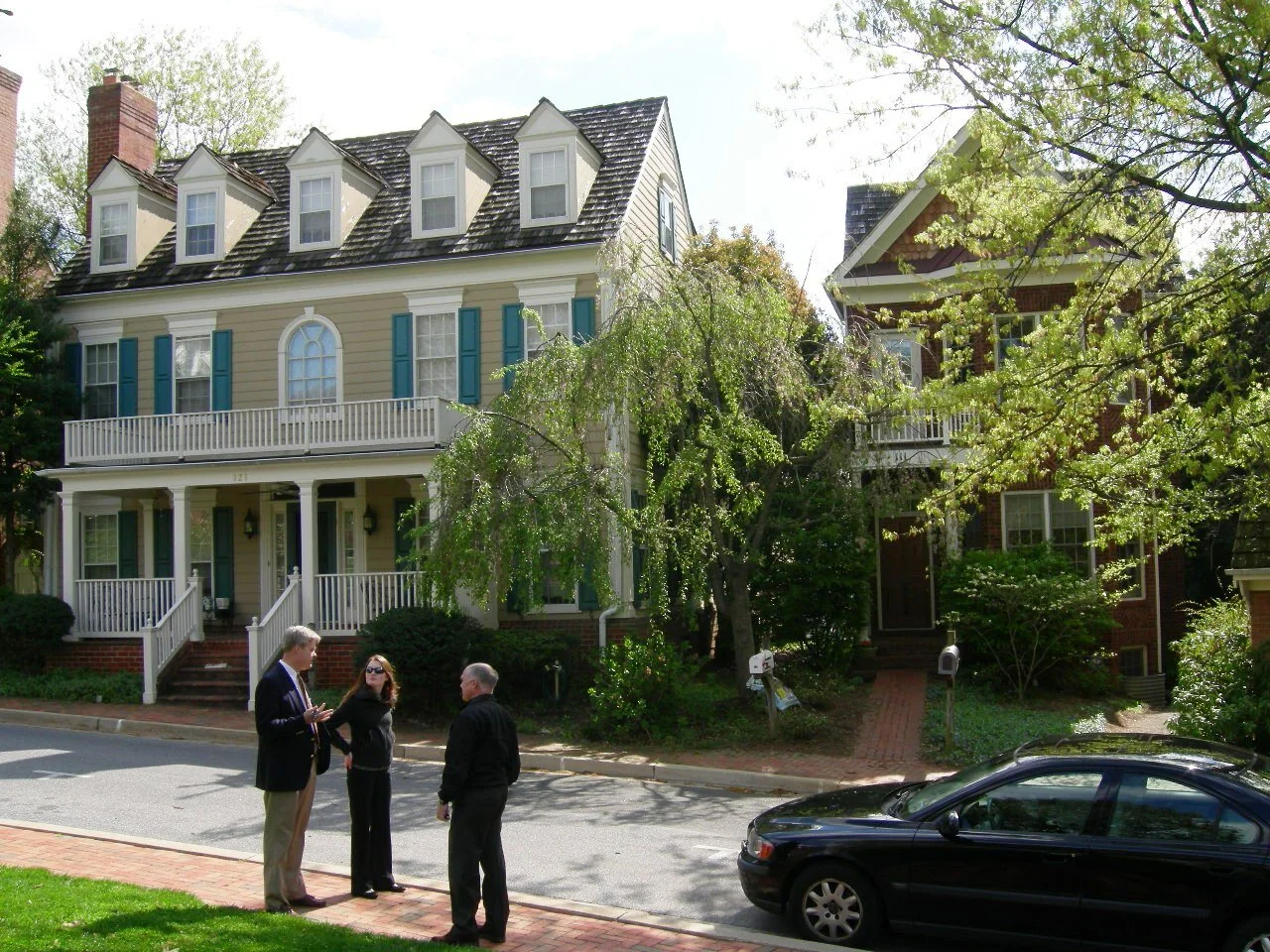
TND Example | The Kentlands (Gaithersburg, MD)

TND Example | The Kentlands (Gaithersburg, MD)

To date, there has been a degree of hesitation towards wanting to proactively position church-owned land to emit a more cooperative development pattern for the creation of LDS Wards.  The hesitation has mainly stemmed from a fear of whether there would be market acceptance, by the development community specifically and the consumer market in general, for a TND pattern.  There has also been a concern regarding the ability of the development community to effectively change their habits, practices and behavior surrounding the level of comfort that presently exists for developing under the regulations and policies that yield the more dominant CSD patterns.

Over the course of the past ten years Daybreak, in South Jordan (Utah), has been operating using a self-imposed system which yields TND patterns.  As we have analyzed the impacts of ward creation in Daybreak, due in part to the outputs associated with the TND pattern and the more diverse mix of housing that exists, a strong correlation materializes with a more optimal balance of the membership within the LDS Wards impacted by the TND patterns.  Daybreak is far from ideal though.  There is still a tendency, even within Daybreak, to concentrate certain housing types (much as is done when CSD patterns are prevalent) which does carry with it less than ideal conditions within the Wards where these clustering situations exist.  With that being said, what Daybreak has provided is a set of circumstances which allows for the analysis and measurement of the more effective TND patterns.

Daybreak (South Jordan, UT)

Daybreak (South Jordan, UT)

Daybreak has also been able to demonstrate unprecedented market strength for their TND neighborhoods.  Over the past ten years Daybreak has exhibited a commanding market presence which has consistently allowed them, to outperform the rest of the Wasatch Front market in new home sales.  On average, Daybreak sells one out of every five new homes along the Wasatch Front.  Daybreak also demonstrated a market resiliency during the economic recession (2007-2011) that was unprecedented in the Wasatch Front Market – real estate sales remained healthy, while the general depreciation of home values was a fraction of what was experienced outside of Daybreak.   All of this has been done in spite of its less efficient location in the southwest quadrant of Salt Lake County and its view of and proximity to the largest open-pit copper mine in the United States.  Daybreak has masterfully shown that a robust market exists for TND patterns.

Daybreak with Kennecott Copper Mine in background (South Jordan, UT)

Daybreak with Kennecott Copper Mine in background (South Jordan, UT)

A good friend of mine (Dan Parolek with Opticos Design in Berkeley, CA) has been influential (among others) in assisting Daybreak with achieving their extraordinary success.  Dan has been able to work directly with both the Daybreak development team as well as some of the Daybreak builders on their housing product strategy.  Dan is particularly well positioned to assist in this role due to the research and analysis that he has personally done on what he refers to as the “missing middle” of the housing market.  Dan has defined the “missing middle” as a cross section of multi-unit or clustered housing types, used historically, which have been effectively deemed illegal in most cases and extremely difficult in others based on zoning practices which favor only a few of the alternatives which might otherwise be available.

“Missing Middle” Housing Examples (Source: Opticos Design)

“Missing Middle” Housing Examples (Source: Opticos Design)

Over a number of years Dan and I have discussed the potential of his “missing middle” for providing both market bandwidth and a broader palette for generating neighborhoods that would be more conducive to the creation of LDS Wards.  The opportunity exists in being able to provide a wider array of housing types and in doing so providing a physical environment that can serve in balancing the membership mix of an LDS Ward in the short term, while also providing an ability for a Ward to rejuvenate the necessary demographics for a healthy membership balance in the long term.  Dan’s work has provided a platform which could potentially rectify the challenges associated with CSD patterns and their negative impacts on LDS Wards if the “missing middle” can be more directly applied through zoning policies becoming friendlier towards their application through the use of TND patterns.

The opportunity and challenge is determining whether taking this type of an approach is something that is willing to be undertaken.  The benefits and impacts are virtually irrefutable based on the analysis that has been done to date.  The question left to be answered is whether there is an interest and desire to work towards the more effective development patterns.  The market is there; the opportunity is there; it simply comes down to a question of whether the fortitude is there.

Plat of Zion Recognized

UDU Legacy Award (2015)

Urban Design Utah, a collaborative committee of professional organizations in Utah, recently presented their Legacy Award to the Church of Jesus Christ of Latter-day Saints for the contributions made by the Plat of Zion towards urban design in Salt Lake City.  Thanks should be given to Urban Design Utah for this recognition because of what it means in the way of attention and focus regarding what the Plat of Zion is.  I have had the good fortune during my time working for the LDS Church to both study and analyze the Plat of Zion – both from its historic perspective, as well as its validity in present times.  I believe that you will find it as no surprise that it is just as relevant today as it was when it was first implemented back in the 1830’s.

Between the years 1830 and 1930 the Church of Jesus Christ of Latter-day Saints undertook a community building initiative that is unprecedented in human history.  During that time period Mormon Pioneers settled 757 communities.  In Utah alone there were 443 communities that were settled.  One would think that with this vast number of communities, of varying size and scale, which were settled during this time period there would be a large number of failed efforts.  Interestingly enough, the failure rate was only 10%.

Plat of Zion

This is part of the reason why the recognition being provided through this Legacy Award is so valuable.  This award recognition helps to draw attention to the wisdom that exists within the Plat of Zion as an operating system for delivering communities that are able to best serve the people who reside within them. The historic application of the Plat of Zion was brilliant in both its principles and its execution.  It delivered both quantity and quality simultaneously.  The Plat of Zion did this using values and doctrines that have been further validated in more recent days.

As Dr. Michael Larice correctly noted when he contacted me regarding this award, the individual that should truly be here accepting it ought to be Brigham Young, because he was the master implementer of the Plat of Zion.  Unfortunately, he was not available to attend.  If he could have been there to accept the award however, I believe he might have said something along the lines of this quote he made regarding the values of the Plat of Zion:

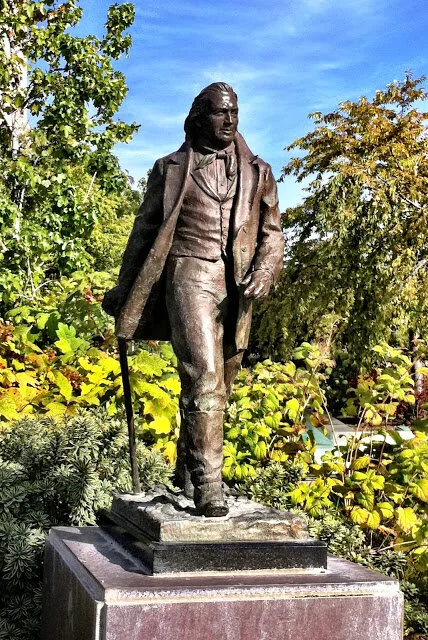
Brother Brigham

Brother Brigham

“Let us train our minds until we delight in that which is good, lovely, and holy, seeking continually after that intelligence which will enable us effectually to build up Zion, which consists in building houses, tabernacles, temples, streets, and every convenience and necessity to embellish and beautify, seeking to do the will of the Lord all the days of our lives, improving our minds in all scientific and mechanical knowledge, seeking diligently to understand the great design and plan of all created things, that we may know what to do with our lives and how to improve upon the facilities placed within our reach.”

The genius of the Plat of Zion and its execution has not gone unnoticed by others who have both studied and analyzed its principles.  Within just the past few years I had the opportunity to work with Andres Duany on a project that included looking at the direct applicability of the Plat of Zion in today’s environment.  He became absolutely fascinated with the Plat of Zion and has since that time been touting its value around the globe speaking of its benefits.  At a Utah League of Cities & Towns event, back in 2010, he provided a very interesting comment regarding the Plat of Zion:

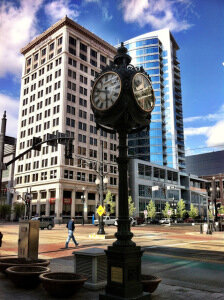
Salt Lake City - 1st & Main

Salt Lake City - 1st & Main

“You have a Ferrari in the garage and you have never taken it for a drive – you have never shown what it could really do. You are taking your Ferrari and you are using it as a dump truck. You have turned this Ferrari of a block, you have turned this Ferrari of a right of way, and you have actually turned it into a utilitarian mentality rather than a poetic mentality – the utilitarian mentality has taken it over. You have never been shown what the City of Zion can do.”

“I am pretty convinced that however beautifully this Plat of Zion worked -and remember it did work – it has lost its way. Many of the things that make your suburban sprawl so easy were not the intention of Brigham Young. I’m not putting HIM in hot water – I’m putting YOU in hot water.”

The Plat of Zion, as an operating system for delivering community, has been infected by a virus that has made it difficult for it to deliver in the fashion that was intended – that virus, as Andres Duany noted, is SPRAWL.  I am hopeful that this infection can be healed, because there is still so much to learn.  The recognition being provided through this award should help in drawing attention to the merits of the Plat of Zion.  On a very personal level I thank Urban Design Utah for that.

To close I would like to share a poem – by Edwin Markham, entitled “Man-making”.  This poem, I believe, emphasizes the most important aspect of the Plat of Zion – that, being the creation of places that contribute to the bettering of people.

We are all blind, until we see

That in the [universal] plan

Nothing is worth the making if

It does not make the man.

Why build these [buildings] glorious,

If man unbuilded goes?

In vain we build the [world], unless

The builder also grows.

Faith and Freedom – Forging American Frontiers

Source: Al Rounds

Source: Al Rounds

“Early settlement patterns on the American frontier often reflected the hopes of religious idealists’ of creating new social structures upon the sparsely inhabited land.  Although widely divergent in theology, religious groups were alike in their desire to forge new, faith-based societal frameworks.  Early American communities such as Kirtland, Shaker Heights, and Nauvoo are cultural artifacts that reflect the disparate visions of religious groups. Salt Lake City is arguably the most successful, functional community founded on religious ideals based on longevity. Choices were made concerning spatial hierarchies and land distribution that reflected collective values.  Because their urban plans controlled settlement patterns, these communities’ faith-based beginnings remain a part of the landscape today.”

With this collaborative statement of my distinguished colleague, Michael Hathorne, and mine as a backdrop, an hour and a half contemplation and discussion among latter-day urbanists recently took place in the shadow of the everlasting hills surrounding downtown Salt Lake City during CNU 21.  As moderator of the panel of faith-based urban professionals gathered to the west, my bona fides were as developer of Kentlands, a pioneering, traditional neighborhood development in the Maryland suburbs (which celebrated its twenty-fifth year of birth in 2014). Listening to my panel colleagues as they outlined their thoughts on community to me in the weeks leading up to the forum discussion in Salt Lake City, I retrospectively compared the tug of faith that must have nudged Aristotle 2,300 years ago and surely heavily influenced mid-nineteenth century utopians, with my own introspective promptings that pestered me day and night in 1988.

“The liberal man will need money for the doing of his liberal deeds, and the just man too will need it for the returning of services; and the brave man will need power if he is to accomplish any of the acts that correspond to his virtue, and the temperate man will need opportunity; for how else is he or any of the others to be recognized?

But the man who is contemplating truth needs no such thing, at least with a view to the exercise of his activity; indeed they are, one may say, even hindrances, at all events to his contemplation.

If happiness is activity in accordance with virtue, it is reasonable that it should be in accordance with the highest virtue; and this will be that of the best thing in us.

Art is the well doing…of what needs doing.”

All my life I have been in love with homebuilding, the business of my ancestors; it is something in my DNA. A soul-numbing dreariness of the thousand-shades-of-beige subdivisions slung like hash across the suburban landscapes seemed to a penance the country had to endure for the Vietnam War. Repentant, though not discouraged, my soul took solace in believing I could do better. I built a few houses with real front porches and real clapboard siding: Mom, apple pie, and the street I grew up on in Bethesda. Not a complicated business plan, but a truthful and powerful one that struck chords in the heart and coincided with the swelling confidence and wallets of the Reagan Revolution sweeping the country. I had discovered a nascent niche in the market and was soon building houses here and there, and then everywhere. I realized my customers wanted everything I saw in my head and felt in my heart, and that I was adding to my plans as fast as my pencil and building permit changes would fly (sometimes faster!): the setting, the scale, the sidewalk, the place. They even wanted the dog on the hearth, if it was an option. They wanted everything that made a whole community and what I was then subconsciously marketing as neighborhood.

The Kentlands - Gaithersburg, MD (Source: DPZ)

The Kentlands - Gaithersburg, MD (Source: DPZ)

Fast forward a few years – Kentlands was already unique in 1988 when I bought it: the lakes, the woods, the buildings, the land. It had charisma – a divine gift. Charisma is an ineffable aura that derives from spiritual qualities that not only elude finite definition, but also cannot be purposely created and cannot be copied. When man-made places have charisma, it is not only building materials or arrangements that give them that special magnetism. It is the spirit of those who made them, and of those who dwell therein. In such places, man, structure, and landscape become one and moves the person from deep within to become more than otherwise possible. Charisma is a spirit-stretcher and, being solely spiritual in essence, might be said to be the language of God.

Most of the focus of community building in the real estate industry is, as it was in 1988 when Kentlands was given birth to in a barn, still given to engineering, traffic control, the environment, the ratio of housing to shops, the precise number of “feet on the street.” This is done to meet sophisticated formulas of generating ROI. However, those qualities that most define the nature of our being – our humanness – are rarely considered and almost never addressed as value to the bottom line by the industry.

md-kentlands-002.jpg

Kentlands was blessed with an enormous range and depth of creativity of its founders, of which there were many. It enjoys an authentic uniqueness because of the unabashed love of those who worked to bring it into existence. Kentlands projects a depth and breadth of concern for the individual more than other competing and contemporary communities do. Think of small towns you may have visited and how you marveled at their warmth, charm, and civility. Remarkably, this is what Kentlands has been able to emulate, surrounded by miles upon miles of dreary, suburban landscapes of metropolitan Washington, DC.

In our passion to escape the big cities to find a better life, we left behind the things that make life better. Across the United States, families want to return in lifestyle and desire to the life patterns of the ‘American Dream.’ Muddled and obtuse, it has become an ideal almost bereft of meaning and context within the ironic interpretation of a 2013-fractured democracy.  And so as if wishing to put as much distance as we can between us and ‘The Situation Room,’ and ‘Closing Bell,’ we want to go even further back in time. This is especially true of the Millennial, or so-called ‘Generation-Y’ who seem to want to find that time when most of a person’s aspirations and interests were fulfilled within the boundaries of the community in which a person dwelled, and when public places and buildings serving civic and social purposes reflected loftier purposes and neighbors looked out for and cared for one another rather than peeking through window blinds in paranoia, heads ducked low.

md-kentlands-022.jpg

There is much about Kentlands that can be criticized for falling short. Unlike the City of Enoch, it is not perfect. But perhaps the most important thing of value I have learned that was created there is simply when good design is paired with freedom of spirit, behavior is affected in extraordinarily positive and uplifting ways. A sense of ‘ownership’ of the community is claimed and taken to creative heights in its own way by every resident, merchant, and tenant occupying their space within the boundaries of the place. Kentlands still evokes strong emotions in me, just as it did when I first laid eyes on it as Mr. Kent’s washed-out, utopian experiment in 1988. It subsequently has become a new and greater experiment in building a modern American real estate development in a new way; a timeless way. The Kentlands experience has taught me that beauty, art, the well-doing of what needs doing is a process that brings order out of nothing but ourselves; it cannot be attained, but will happen of its own accord if we give it the freedom to do so.

As a truthful missionary would say: “Don’t believe me. Go and find out for yourself.”

Faith and Urbanism

Therefore, when we build, let us think that we build forever. Let it not be for present delight, nor present use alone; let it be such work as our descendants will thank us for, and let us think, as we lay stone on stone, that a time is to come when those stones will be held sacred because our hands have touched them, and that men will say as they look upon the labour and wrought substance of them, ‘See! This our fathers did for us.’”  – John Ruskin –

picture1.jpg

How do we create lasting value and a sense of permanence or timelessness in our designs. This to me is the ultimate sustainability. I believe we must look to the past, learn from it, and ultimately build on the best that has been done.  We should resist trends, and innovation for its own sake, and seek to study and understand the very best time tested examples in order to understand the long-term ramifications of our choices.

picture2.jpg

23 years ago, prior to ever hearing the words new urbanism, neo-traditionalism, TND or Urban Village Movement, I looked around me and knew there was something wrong with the way we planned communities.  About this time I moved to England as a young college intern, and while living in a beautiful neighborhood in London’s West End, I discovered a quality of life that I had not experienced before. Based on this experience, I submitted a research proposal to the University of Cambridge, Department of Land Economy, to study the communities of London’s West End.  The purpose of my research was to attempt to understand how they had been created and perhaps even more importantly, how to create places like them once again.  In keeping with the principle of examining some of the best that has been done, I turned to the Grosvenor Estate, of the Duke of Westminster.  

You may be familiar with the Grosvenor Estate, which includes some of London’s most beautiful and desirable neighborhoods, including Mayfair and Belgravia. In the process of my research, I became familiar with the concept of hereditary land-ownership and came to appreciate the long-term interest this system cultivates.

picture3.jpg

The great wealth and high social position of these aristocratic families meant that their interest in the development of their properties generally extended far beyond the purpose of short term profits. Most of these families would approach development decisions without the constant preoccupation of immediate financial returns, and instead focus their attention on enhancing the long-range value of their estates.

Today, as it was then, greater harmony between the self-interest of the landowner and the interest of the community is attained when the landowner, striving to protect the long-term capital investment of his property, works to preserve and enhance the desirability of the estate overall.  Getting things right is more important than short-term profits.  Immense financial returns have proven this approach to be a wise one. In the case of the Grosvenor Family, careful estate management and their personal desire to see the improvements of their properties have been rewarded by the vast accumulation of personal wealth, which allows the estate office to continue to make decisions based primarily on the good of the community.

Of all the things I learned from my experience with the Grosvenor Estate, I would like to share with you what I feel is the single most important, as summarized in the final paragraph of my dissertation:

 “Though the estate today is a commercial enterprise, the Duke of Westminster is first and foremost an historic landowner. If we can learn anything from the aristocratic land developments of the eighteenth and nineteenth centuries, and the unique ownership system which not only created them, but has served to preserve them for us today, it must include the essential principle of stewardship for our land, assuming a responsibility for what we as stewards will pass on to subsequent generations.”

 Gerald Grosvenor, the current Duke of Westminster, shared this very personal insight with me on how he viewed his role:

picture5.jpg

“I don’t own this land. I am the steward of this land for a season. It is my responsibility to protect it and pass it on to future generations, in a condition of at least equal value as I received it, or hopefully much improved.”

This beautiful vision for creating community incorporates on all of the principles of traditional urbanism.  The daily needs of its residents are met within walking distance of their homes. There is a mix of housing types and income levels throughout the community.  While Mayfair and Belgravia are two of the world’s wealthiest communities, it would surprise most people to know that the Grosvenor estate provides Peabody (or affordable) Housing throughout their developments.

picture10.jpg

The Estate also provides housing for many of the caretakers. When these employees are too old to continue to work, the estate continues to provide housing for them in the community where they have lived all their lives.  When I talked with His Grace, he stated that these individuals are the very heart of his communities.

They provide the much needed daily activity that supports local stores.  Without them the corner shops would close, demand would drop, and property values would fall. His Grace knows that it is the right thing to do, but he also demonstrates a keen understanding of how these principles contribute to the the long-term desirability of his communities.

Failure to understand the far reaching consequences of creating communities where people can’t walk and everyone is of a particular income level has already lead to  devastating consequences.

Several years ago I came across a book after I heard the authors being interviewed on the Today Show. In the Two-Income Trap, Harvard Law Professor, Elizabeth Warren and her daughter Amelia explore the question of

picture6.jpg

“Why today’s two-income family earns 75% more than its single-income counterpart a generation ago, but actually have less to spend.”

And “Why the average-middle-class family can no longer buy a home unless both parents work. I was fascinated by the answer because it confirmed what I had discovered several years earlier.

“The Second Car” which the authors mentioned specifically:

“Once an unheard of luxury within the middle class, the ‘Second Car’ has become a necessity.”

This is just one of the many devastating effects of failing to follow time-tested traditional planning practices. For those who want to understand these issues more I suggest reading Suburban Nation.

In contrast to the principle of stewardship, I present the following story from Hugh Nibley’s book Approaching Zion.  He states:

picture7.jpg

“I spent my mission among the fields of Europe, which had been under the plow for literally thousands of years and were still yielding their abundance.  After my mission I visited a glorious redwood grove near Santa Cruz, California.  Only there was no grove there; the two-thousand-year-old trees were all gone; not one of them left standing. My own grandfather had converted them all into cash. Grandfather took something priceless and irreplaceable and gave in return a few miles of railroad ties. In those days, we enjoyed a feeling of immense prosperity through the simple device of using up in twenty or thirty years those reserves of nature’s treasury that were meant to last for a thousand years. There’s no permanency in economy that takes a hundred from nature and gives back one. There’s no survival value in such an operation, which is certainly the business of systematic and organized looting—the very opposite of making a fair exchange with the earth. Above all, it ignores the ancient doctrine of man’s obligation to “quicken” the earth that bears for him. The old Jewish teaching is that Adam had a right only to that portion of the earth that he “quickened,” on which he labored with the sweat of his brow. Let us not confuse the ethic of work with the ethic of plunder.[1]

picture8.jpg

I would like to conclude with another key element which I feel is essential to creating communities of lasting value but is rarely discussed – in fact I think it is purposely avoided – and that is the principle of beauty.  Beauty it is an essential part of the dialogue on timelessness.   How do we insure timelessness in our architectural designs?  We follow the same process, we look to the past and study that which has successfully withstood the test of time.  The principle of beauty was very much a part of early Mormon settlements. In a revelation to the Prophet Joseph Smith in 1832 He taught that Zion’s virtue and beauty go hand in hand – “For Zion must increase in beauty, and in holiness.

Carma de Jong Anderson tells us that when Joseph Smith and the early Mormons arrived in Commerce, Illinois, on the banks of the Mississippi River in the summer of 1839 they found a half dozen families living there and as many as 30 vacant log cabins abandoned by homesteaders. An unhealthy bog harbored a malarial fever usually followed by pneumonia and often by death.  But Joseph Smith envisioned possibilities so resplendent that he renamed this spot on a bend in the Mississippi River Nauvoo – a Hebrew word meaning “beautiful” or “beautiful place.”

 “The Saints bought four acres on a glorious rise of land for their temple—the focal point of their spiritual vision. They immediately set to work digging drainage ditches to divert water from the flats, and soon the stagnant pools of malarial water began to disappear.  In the first year after the Saints began arriving in Nauvoo, 250 houses were built.  By the next year 1,200 structures had been built. By 1845 Nauvoo had 11,000 citizens, rivaling the population of Chicago. Some people referred to Nauvoo as “the great city in the wilderness.”’ [2]

picture9.jpg

I have sat on a hill in Nauvoo overlooking this bend in the Mississippi River just as the sun was setting. There I reflected on the truly magnificent achievements of a people united by faith, and marveled at what they had created.  Joseph Smith’s choice of the name Nauvoo, or “beautiful place” reflected the fundamental belief that they were to create more than a place to live, they would carve out a beautiful city for the cultivation of the human spirit. If we fail to understand this principle—we fail to understand a key element of these places.

Let us build on the best of all our traditions by carefully studying those communities that have successfully withstood the test of time.  Let us build upon that which has worked, attempt to understand that which did not, and continue to build upon the very best that has been done so our work will be of lasting value.  Let it be such work as our descendants will thanks us for, and say, ‘See! This our fathers did for us.’


[1] Hugh Nibley, Approaching Zion, Salt Lake City, Utah, 1989, p. 10-11

[2] Carma de Jong Anderson, “In Beauty and Holiness: The Cultural Arts in Nauvoo,” Ensign, Sept. 2002.