Identifying the “Sabermetrics” of Urbanism

Can successful places be driven by key metrics in the same way Billy Beane assembled the 2002 Oakland A's? How about a little Moneyball for Community Building.

“For forty-one million, you built a playoff team. You lost Damon, Giambi, Isringhausen, Peña and you won more games without them than you did with them. You won the exact same number of games that the Yankees won, but the Yankees spent one point four million per win and you paid two hundred and sixty thousand. I know you’ve taken it in the teeth out there, but the first guy through the wall always gets bloody, always. It’s the threat to not just the way of doing business, but in their minds it’s threatening the game. But really what it’s threatening is their livelihoods, it’s threatening their jobs, it’s threatening the way that they do things. And every time that happens, whether it’s the government or a way of doing business or whatever it is, the people who are holding the reins, have their hands on the switch — they go bat shit crazy. I mean, anybody who’s not tearing their team down right now and rebuilding it using your model, they’re dinosaurs. They’ll be sitting on their ass on the sofa in October, watching the Boston Red Sox win the World Series.”   –From the movie Moneyball: John Henry, Boston Red Sox owner

I have spent more hours then I care to admit studying the book and movie Moneyball. Both the book and the movie resonate with me. I grew up playing baseball. I played baseball in college. The sport of baseball appeals to my cerebral nature.  It also resonates with me because I see parallels in the story of Moneyball to what is presently taking place in how I believe our built environment is starting to be weighed and measured.

For those that may not be familiar with the story, Moneyball follows the General Manager of the Oakland A’s, Billy Beane, during the course of the 2002 baseball season as he works to keep his team competitive with a small market payroll that is a mere fraction of the big market teams (i.e. New York Yankees).  Billy Beane embraces the use of “sabermetrics”, which is a system for evaluating baseball players using the objectivity of statistics rather than the subjectivity of baseball scouts. Baseball players have been evaluated since the game’s inception by individuals who are measuring talent based on intuition and gut feel. This method of measurement is an inexact science and is littered with bias. A player with tremendous talent might be judged negatively because he “waddles like a duck” when he runs or “looks funny in his baseball uniform,” which probably doesn’t have any bearing on his ability to hit a baseball or throw a strike from the pitcher’s mound.

I believe there are parallels to how our built environment is measured. I believe there are “sabermetric” standards by which urbanism can and should be measured. I believe there is a fear of the shift that will come as these metrics are identified because it means an end to how many have done things and a potential end to their livelihood unless they accept the paradigm shift that we are in the midst of.

“You’re living in the past, boys – thinking about this all wrong. Cities today need to do a lot more with a lot less. Pete, gimme the metrics.”

“You’re living in the past, boys – thinking about this all wrong. Cities today need to do a lot more with a lot less. Pete, gimme the metrics.”

What first has to be understood is identifying the factors that are critical for determining the WHAT and HOW for effectively measuring urbanism. After an extremely stimulating dialogue with fellow Urbanists and friends that I both respect and trust the following factors were identified:


Take a general approach to identifying the metrics of urbanism

Before specific metrics can be identified, the general nature of what is important to measure must be determined. Good decision making often needs discipline to not get ahead of one’s self before understanding what needs to be done.

A good starting point would be to identify the general categories that could potentially be measured that would be contributing factors to great urbanism. Taking an initial first stab at this the categories might include the following:

Make certain that any metric used is measuring appropriately

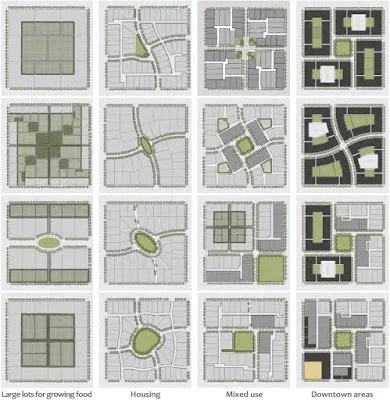
Urbanism isn’t a recipe that can simply be followed in order to create great places. Urbanism is much more complex than that. The metrics of urbanism aren’t going to directly correlate like a recipe for German Chocolate Cake. Rather, urbanism and the way it is measured must be thought of more as a living entity than an inanimate object. There are a multitude of conditions related to land that will determine the appropriateness of certain measures over others. Measuring inappropriately could potentially lead to measuring the wrong things, the wrong way, and/or with incorrect reasoning. While some principles may work generally for all (i.e. connectivity), other principles may contain higher degrees of sensitivity due to specifics relative to location (i.e. how connectivity is achieved).
Source: Duany Plater-Zyberk

Source: Duany Plater-Zyberk

For example, block size. This is one that I have a direct sensitivity to because of where I work and live and the often negative connotation associated with Salt Lake City block sizes. There are arguments to be made that a 10 acre block is BAD. If the metric rule is that anything above a particular block size is BAD then Salt Lake City is the bane of urban design.

What I have learned through work that has been done by both DPZ and PlaceMakers is that what can potentially make the Salt Lake City 10 acre block detrimental is the application of the 10 acre block, not the size of the block itself. I have heard Andres Duany speak on multiple occasions as to the built-in benefits and flexibility that exist in a Salt Lake City block which other cities with smaller block sizes will never be able to achieve. For example, the 10 acre block, when broken up, can emit a myriad of possibilities that the 2 acre Portland block can never offer.


Work to properly weight the metrics so as to not overly prescribe and hinder the art of creativity

There is an important need to balance art and science. A delicate balance between the two for the purposes of creating great urbanism must exist. This is why the identification of the proper metrics is so critical. Whether we like it or not the nature of land development requires the use of metrics to regulate and govern. This is why I am such a tremendous advocate of the use of form-based codes. Their use “changes the game”, in my opinion, in terms of how our built environment is allowed to be created.

At the same time, we have to be careful about over prescribing and/or not allowing for proper subsidiarity in what is prescribed and when certain decisions are supposed to be made. When either of these instances occurs creativity can be (and usually is) stifled. This can often hurt the opportunity of finding better solutions that could potentially become the new benchmark standard(s) of measurement.

This, in part, is what drew me to the potential correlation between Bill James’ “Sabermetrics”, as discussed in Moneyball, and the necessity to understand what metrics need to be identified in order to effectively measure what urbanism produces. In my mind this is necessary in order to justify the decisions that need to be made regarding the creation, operation, and maintenance of urbanism. We are currently in a period of time where metrics are governing land development with an iron fist on both the financial and governmental sides of the equation. One of my concerns is that if the wrong metrics are used to measure (as in baseball) less effective decision making occurs. This is potentially worse than simply being subjective and going by gut feel. Subjectivity at least requires a working knowledge and first-hand experience. Hiding behind the WRONG numbers, regarding something as difficult to correct as an already built development project, could take decades to correct (if ever).


Include metrics that support broad “market bandwidth”

There is an integral need for flexibility and diversity in system and output. We need systems that allow for a broad level of bandwidth, rather than one that is constrained and narrow. As noted previously, we are subject to economic forces that have to be considered. If one wants to achieve success, from a business standpoint, the means by which absorption can be maximized requires the greatest number of product alternatives with the ability and right to deliver as warranted by market acceptance and a system (regulatory policies) under which this can be delivered. The commodity “output” in real estate is land and the most efficient method for absorption is being able to package it with a multitude of different product alternatives.

Put into the form of an analogy, if you consider that all sandwiches have bread in common, the best way to create “market bandwidth” for the absorption of bread is to have a multitude of alternatives to pair bread with different ingredients that will create different sandwich alternatives. While peanut butter & jelly is a popular sandwich there is room in the market place for other sandwich types. General market acceptance of peanut butter & jelly shouldn’t justify policy constraints to limit other sandwich alternatives. Allow for other sandwiches (market) with parameters for how other sandwiches are to be provided (system)


Recognize the built-in uncertainty due to the “human” factor

Consideration should be given towards a human being’s rights regarding free will (ability to choose) that are associated with the human condition. If there were no free will then urbanism could be entirely formulaic. However, there is the need to understand that certain things can and should be measured. Urbanism should not be subjective, yet at the same time it should also not be ENTIRELY objective.

It is also important to recognize the relationship of disorder in the creation of good urbanism. Disorder is going to be a reality. It will exist, when it comes to the creation of our built environment, due in part to the previous point raised regarding free will. Human beings, through their ability to choose, create a natural level of disorder to everything that they engage. This point is why becoming overly reliant on metrics can be dangerous.

In conclusion, the question I wish to pose is, “What are the Sabermetrics of Urbanism?” What are the metric standards that, when identified, show the true nature of how we should be looking at our built environment in order to determine what is healthy, efficient, socially strengthening, and economically sound? Paraphrasing an idea from Moneyball we need to “challenge the traditional understanding of urbanism by questioning the meaning of its statistics.” If we do this I am confident effective metrics for great urbanism will be found.


Contact Us

An Argument FOR Housing Choice

Our development patterns are the culprit in whether a ward (or a neighborhood) is going to function in a sustainable manner. The homogeneous elements of DNA in our present development patterns make it difficult to impossible to deliver well-balanced and positively functioning neighborhoods. To deliver a neighborhood which is made up of a diversity of housing types within its boundaries is virtually obsolete. Zoning practices (the DNA of our development patterns) require the homogeneous delivery of housing.

New Urbanism’s Future – Utah Edition

TRAX - Downtown Salt Lake City

TRAX - Downtown Salt Lake City

I have been a member of the Congress for the New Urbanism (CNU) for over 15 years. In fact, one could argue I have been affiliated with CNU for my entire professional career. CNU has certainly shaped my thinking for longer than my awareness of CNU as an organization. I have allowed that influence to drive me professionally to the point of having been put in the position of having to choose between where to live and New Urbanism – choosing between professional relationships and New Urbanism – choosing between employment opportunities and New Urbanism. New Urbanism won out every time. Why? Because it is the absolute correct mindset for making decisions which face us in the present and the foreseeable future. When I say that, I am speaking specifically about Utah, the Wasatch Front and the challenges that are presently staring us in the face.

The first (and most important) step in understanding the general nature of what New Urbanism is and how a New Urbanist thinks is to read the Charter of the New Urbanism. This is important because it’s the principals of the Charter which become the lens through which one is then able to identify solutions to problems which exist. Utah has problems like other parts of the country, but also has issues which are specific to Utah because of its geography, culture, and circumstances.

Next, when I contemplate the future of New Urbanism from the perspective of the state of Utah, the natural order in organizing my personal thoughts was to think about where we are in the present here in Utah. Where are we today, where do things stand, and where do the challenges exist as we move forward?

Salt Lake City - 1st & Main

Salt Lake City - 1st & Main

In taking this approach, I identified four related areas that I believe are the hot button issues, and they all tend to focus on the primary issue which Governor Herbert spoke about in his State of the State address: Growth. His focus was more specifically about economic growth – the health and robust nature of Utah’s economy. With that kind of positive prosperity comes a desire for those outside of its benefits to want to plug in and be part of that. Utah, for a number of years going back, has been a very healthy economic environment to come into; and so if you follow future trends reporting put out by those such as the Kem C. Gardner Policy Institute, they talk about what’s going on in the way population growth. We’re seeing some key things taking place.

For a number of years, much of Utah’s growth has been internal to the state, and of course we are seeing now that the numbers associated with the historic self-population are dropping while simultaneously the in-migration into Utah is rising.  This is a crucial aspect of our growth that we absolutely have to understand as it pertains to what our future is now. Our changing demographic makeup in turn connects to three other aspects of how growth must be looked at, studied, and accounted for. I like to identify these three as social inclusion, environmental stewardship, and fiscal responsibility.

photo-sep-15-6-20-40-pm.jpg

Social Inclusion: As people are choosing to become part of Utah’s Wasatch Front, the dynamics are changing what is desired in terms of how we live and operate. With these changes comes the need to put together our built environment differently. One of the key aspects of that is we need to look at an approach to providing mixed-density housing which is much different than what we are doing today. What we do today is concentrated and segregated density by housing type. This housing segregation creates a separation in our communities that plays into other social aspects that are part of this discussion but should be saved for another time.

img_1436.jpg

Environmental Stewardship: We understand that along Utah’s Wasatch Front there are key issues dealing with air quality, water availability, and land scarcity. We are going through a time period in which our air quality fluctuates between moderate and extremely poor. Land scarcity is another issue. I believe that we all understand that we can’t grow land – It’s a finite resource, the remainder of which we now, more than ever, must carefully manage.  While some may think that there is still room to grow in Utah County’s Cedar Valley, that idea is a fallacy of the last of these issues – water availability. Water is also a finite resource and can only go so far in terms of assisting in the expansion of growth.

Fiscal Responsibility: The role of fiscal responsibility falls into two areas. The first pertains to the building, operation, and maintenance of the infrastructure which is required to feed the growth machine. The required funding for public utilities and transportation infrastructure must come from somewhere – but it also must be distributed in a conscientious fashion. And so there’s a responsibility at both the state and local levels of government to deal with the present and future tax base and how we do that in a fiscally responsible manner.

Daybreak - South Jordan, UT (Source: Jason Yeaman)

Daybreak - South Jordan, UT (Source: Jason Yeaman)

As it pertains to my world as an urban planner and the way that I try to focus my efforts in the planning world – I work really hard in attempting to act as a bridge between public government and private developers. I do this primarily through the issue of zoning.  I am a firm believer that zoning is the DNA to our development patterns.  So, the problems that we face today in terms of how we do things, how our communities are built, how we allow our Human Habitat to grow, are directly related to the rules of local government. Zoning sets that pattern. If we are going to do things differently, then the framework under which zoning is written, operated, and regulated has to change.

I have spent a lot of time sitting with public officials who yell, kick, and scream about the deliverable of the developer, and I’m the first one to argue that what the developer is doing is following the rules of local government. If those public officials want different results, in terms of the development patterns within the cities of the Wasatch Front, they have to change the zoning, because the zoning is what sets the parameters under which the developer operates.  

Not to throw shade just at the public side, the private side also has a responsibility. Their ways of operating are going to have to change as well. What I often hear the developer argue is that the market dictates to them what actually gets built, and so the developer tends to, in my opinion, hide behind that statement.  I’m not a firm believer in this kind of thinking because the market has shown us in different parts of the Wasatch Front, most specifically in Daybreak, that the market is accepting of different development patterns, different housing types, different ways of providing non-residential uses that are extremely different from the pattern that is absolutely prominent from Brigham City to Santaquin. 

Daybreak: Oquirrh Lake - South Jordan, UT (Source: Jason Yeaman)

Daybreak: Oquirrh Lake - South Jordan, UT (Source: Jason Yeaman)

So from my standpoint as it pertains to the future of the application of New Urbanism in Utah, and my personal focus professionally in my career: it all comes down to zoning. We have to change the parameters, the rules, the laws, the ordinances, that govern how development actually takes place along the Wasatch Front. Without these changes, we can do nothing but expect status quo results to the current problems which growth presently delivers us. And with a perpetuation of that status quo performance, we only have ourselves to blame for the results which we already know all too well.

All we need to know about place making can be found in…FOOD?

Creme Brulee

Creme Brulee

The longer I work in the field of urban planning I continue to find a strong relationship between the art of place making and food.  Place making, like food, consists of a relationship between a recipe, the necessary ingredients, and the artisan chef to expertly assemble the ingredients to provide the expected result.  If one would like a crème brulee there is a certain mix of ingredients that are necessary.  A particular recipe must be followed.  A caring and knowledgeable chef needs to be at the helm.  If the right ingredients aren’t used, or the recipe isn’t followed, a crème brulee will not be the end result.

Food is often very dynamic in its creation as are the places that we collectively love.  Great places don’t just happen.  They are no accident.  Recipes are used.  Ingredients are weighed and measured.  The chef executes on the recipe with the necessary ingredients.  These relationships are well understood with food, but are only now being (re)discovered when it comes to place making.

So what are the recipes and ingredients of place making?  Our recipes are the land use policies that a community uses.  This would include conventional zoning codes.  The ingredients for place making include streets, buildings, and civic spaces among other things.  The chef would be all those who make up the decision making process (i.e. government, developers, lenders, citizens).  Zoning (the recipes) tells us how the ingredients can be put together.  In the case of conventional zoning practices the “dishes” that are made (as per the recipe’s instructions) include monoculture neighborhoods, commercial strip centers, and homogeneous office parks.  While this may not be the intention, it nonetheless is the result.

“The new American city has been likened to an unmade omelet: eggs, cheese, vegetables, a pinch of salt, but each consumed in turn, raw.” (Suburban Nation)

Ratatouille (Source: Disney/Pixar)

Ratatouille (Source: Disney/Pixar)

In the Pixar/Disney film “Ratatouille a very important lesson about place making is taught (indirectly) through food that is worth sharing.  Remy the rat is being mentored in the culinary arts by Chef Gusteau. In the particular scene I am referencing Chef Gusteau is explaining to Remy the delight of certain foods when consumed separately.  He tells Remy to take a bite of a strawberry, and to relish in the flavor the strawberry exudes.  Gusteau then instructs Remy to take a bite of cheese and note the nature of the flavor it offers.  Gusteau then tells Remy to consume the strawberry and cheese simultaneously.  When Remy does this he experience an entire different palette of flavor because of the interplay that occurs between the two foods.  The result is something that is unable to  be achieved without the two working together as they do.

The same lesson taught to Remy by Chef Gusteau also applies to place making.  It is through the different application of ingredients that a richness of urbanism can be created that is unique, engaging, and inspiring.  The creation of place is typically not an accident, although it can occur that way.  Just like an award winning recipe, the execution of that recipe by a fine chef, and the use of carefully selected ingredients – will often emit the type of genuine places where people will go out of their way to spend time.  Think of the great places you have experienced in your lifetime and answer these questions: What made those places distinctive?  How did you act differently in terms of your engagement of that place?  What aspects of that place inspired you?  What were the lasting impressions and the impact of those places on you as a person?

The translation between food and place making is a strong one.  These same questions could very easily be asked of a great restaurant that you have experienced.  The differences are just as palatable and easily identified.  It is the difference between a meal at Ruth’s Chris and McDonald’s, in my opinion.

Slow Cooking Urbanism (Source: Tom Low)

Slow Cooking Urbanism (Source: Tom Low)

So what are the lessons to be learned from the correlation between place making and food?

LESSON 1 | Place making requires vision – As in food you have to know what you want to create and take the necessary steps to prepare for the outcome you desire.

LESSON 2 | Place making requires discipline – As in food you have to show commitment to the process that is necessary to achieve the end results that are part of the original vision.

LESSON 3 | Place making demands effort – As in food the desired results will take time and attention if the end results from the vision are going to be delivered.

LESSON 4 | Place making delivers higher returns, both financially and socially – As in food, when the right vision is identified, the right discipline is maintained, and the right discipline is exuded the place making results can be amazing.  The results are often long lasting because the investment in creation often carries over into the sense of investment and ownership for those who engage the place.

The last question to be asked in relation to this topic is – what can one do in order to more effectively generate places as opposed to projects?  There is much that can be done, but it certainly isn’t easy.  The recipes, as presently constituted, require the consumption of ingredients separately.  The end results can be as drastic as emitting Paris, France or Paris, Idaho.  I don’t know about you but I am more interested in Paris, France (no offense to Paris, Idaho intended).

Ratatouille (Source: Disney/Pixar)

Ratatouille (Source: Disney/Pixar)

Learning from Daybreak: Lessons for the Wasatch Front

Anyone that visits Daybreak will quickly and easily recognize that it is different from the more common suburban neighborhoods that are the status quo along the Wasatch Front.  I also know that not everyone is interested or would be comfortable living in Daybreak.  For me, Daybreak works extremely well because it provides all of the things that a suburban neighborhood is unable to provide.

Providing DNA for Transit-Oriented Development

oblique-view.png

Last night, I proudly watched as over six month’s worth of work culminated in the 5-0 vote from American Fork City’s City Council adopting a zoning code for Transit-Oriented Development around their commuter rail (FrontRunner) station. This was not an easy process by any stretch. Undertaking the project required American Fork City to take a difficult look at how the area around their transit station was positioned for future growth and admit the delivery system was broken.

It is far too easy at times, for municipal government, to simply ignore problems associated with their development patterns and point fingers at the development community for the results that follow. This is both an irresponsible and unfair approach to take, because the bottom line is that ultimately it is municipal government that must take responsibility for their growth patterns. It is their rules (zoning) that developers are required to follow which yields the unpopular results.

DNA & Genetic Sequencing

DNA & Genetic Sequencing

A common theme that I reiterated to the city over the course of this project was to take to heart the idea that zoning is equivalent to DNA. As with DNA, zoning sets in motion “genetic sequencing” which is what delivers the end result of the development pattern that is implemented through the requirements set forth by the zoning code. If different results are desired, then different “genetic sequencing” must be established allowing for development patterns that are more in line with the city’s vision.

This theme was especially true regarding American Fork’s desire to integrate a development pattern that would support and enhance their opportunity associated with delivering a fully functioning and supported commuter rail station. Transit-Oriented Development (TOD) is the planning term for the development pattern which works to integrate future development with its relative proximity to transit infrastructure.

ca872-cover.png

When done correctly, TODs deliver a magnifying impact that better serves communities on all fronts (physical place, fiscal return, environmental impact, and common good). The DNA of TODs calls for a set of “genetic sequencing” which is diametrically opposed to what conventional zoning delivers. TODs demand a human habitat which is walkable, mixed-use, development intense, activity rich, and socially diverse. To American Fork’s credit, they understood the general principles of what a TOD is supposed to be and recognized that the zoning code they were using for delivery of these principles was falling short of the intended vision. The difficult decision was made to fix the problem rather than lose the tremendous opportunity if done correctly.

861ae-zoningprocess.png

Analysis was provided to the city as to the specific areas in their existing TOD Code which was failing them. This understanding then allowed for a game plan to be tailored to their needs in order to fix the problems and move forward with greater confidence as to what the development results will be. Last night was the culmination of this process. A zoning code, with the necessary DNA for delivering Transit-Oriented Development, is now in place which has the ability for implementing a future which aligns with American Fork’s vision. I am honored to have been a contributing member to this effort.